Tuesday, October 8, 2013

Book Review: Shivam Singh’s Best Friends

By- Varsha Singh

24 years old aspiring author Shivam Singh impregnates much maturity than his real age.Through his debut novel Best Friends he proves that age has nothing to do with mature sensibility.

Beginning of this story keeps the readers in illusion of so-called regular mushy and love drenched filmy stories with lot of hot-chicks around the young boys pursuing Engineering, specifically around the protagonist and narrator of this novel, Yash Rajawat.

Yash is portrayed as a career oriented person who always desires for fame and success in his life. Being handsome, smart and rich; he lives lavishly in the heart of Hyderabad mostly with his friends and partially with his parents.

He is considered as a charmer, a guy who has dated almost all the adorable beauties around; for whom every next relationship is not be taken seriously rather it just remains  a matter of time pass. The only kinship essential for Yash was with his best friend, Ena. Surprisingly, they were not in a love relationship, but more than that; something more spiritual and eternal. In the words of Helen Keller “I would rather walk with a friend in the dark, than alone in the light.” Both of these friends prove to be the same. Ena and Yash are the craziest friends ever. They behaved and did craziest things altogether, from throwing pop-corns on a kissing couple in theatres, to getting barged out of a bar for kicking a guy for a stupid and funny reason, in fact for reasonless reason.

These friends shared an unbreakable bond with the urge of doing absolutely anything for each other. They were inseparable ones who could literally tear anyone who dared talking crap about the other.

But their destiny had something else in store for them. After one life-changing tragedy everything shatters in their lives.

“There comes a day in your life when you really wonder what wrong had you done that your life has taken such a sudden turn and everything has been torn apart. When I look back, I wonder how things have changed in my life in a matter of days. I lost a friend who meant the world to me. That one friend whom I cherished and treasured more than anything or anyone else……” – Yash

Must say, there is an astonishing surprise in the end of this story which makes a significant mark in the mind of readers.  The conclusion fills tears in the eyes of all… tears of happiness or sorrow? Explore yourself by reading this novel which speaks too much from the heart of best friends.

About the Author

Shivam Singh is an Honours Graduate in Mechanical Engineering and at present working as a Software Engineer at Infosys. Apart from his professional life he does modelling to fulfill his hobby. By choice he is an author. This book proves his dedication towards his writing. His name is also engaged with Salsa dance & swimming. In his leisure time he usually writes in fashion blogs and reviews books. He is also an expert in languages which is evident in his skills of eastern to western languages staring from Punjabi, Hindi to English, Spanish, French. Not only that he also belongs to a versatile family and plans to engage himself in International Business study. In his various embodiments, he has achieved success and surpassed in all possible ways of life. His first creation, this book is dedicated to his best friend.

Book : Best Friends
Author  : Shivam Singh
ISBN  : 978-93-83271-07-8
Price :  Rs. 270.00
Publishing Date: July 2013
Publisher: Power Publishers
Language:  English
Review in association with www.thebookaholics.in 

Monday, September 30, 2013

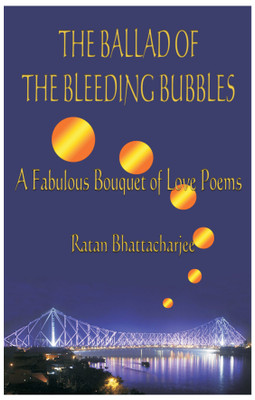
Book Review: Ratan Bhattacharjee's The Ballad of the Bleeding Bubbles; A Fabulous Bouquet of Love Poems

By- Varsha Singh

“Writing since more than two decades, Dr.Ratan Bhattacharjee has earned a name for himself as a poet and a critic. His nostalgia for the lost glories of his race make him a true poet of the soil. He is a gifted poet with a humanitarian approach, fascinated by ecological concerns. Bhattacharjee’s sense of belonging to the socio-cultural moorings widens the scope and vision of his poetry.”
—Dr.Nandini Sahu, Associate Professor of English, Poet & Editor

Ratan Bhattacharjee’s poems are always an uncommon pleasure to read for all the poetry lovers. Being defined by their hospitable grace; they're easy to take in yet anything but superficial: they repay return visits, as I personally feel. After reading his poems, anyone may trace his belief that love is the utmost spirituality which must come before God as well.

After the huge success of his anthology of poems Melodies and Maladies: A Bouquet Of Love Poems the poet comes back with another sensual ecstasy The Ballad of the Bleeding Bubbles: A Fabulous Bouquet of Love Poems with two parts subtitled as Melodies Of Love and Maladies of Love.

How does this poet end up with such intensity of love and passion in his writings? Bhattacherjee clarifies his stand by stating, “These poems of The Ballad of the Bleeding Bubbles are the outcome of my interactions with men and women in reality and dreams. I talk with my characters in my poems and there are still some with whom I had an imaginary conversation. Even the most fabulous characters are all real to me. My passions and feelings are all genuine. They are quintessentially tangible. Like the frustrated people, I never take refuge in Philosophy.”  Well, the poets stand is quite thought provoking and as engaging as his poems.

Ratan Bhattacherjee writes mostly about the agonies of human life, “Legend says, / When you cannot sleep at night/ You may be lost in someone's dream/ Legend says, / When memory is liquid like milk/ Sorrow is its delicious cream. / Legend says, / When you cannot walk alone/ Your hand may be in a good friend's hand/ Legend says, / When you do not see the rivers/ They are lost in the sand.”; about tragic severance, “There is none, none at the/ End of the long road/ Waiting for me at sunset. / My bus moves fast on the highway/ and all around are gay. / There was none that night at the end of meadow/ Where the champaks bloomed in a dark shadow/ I had many moons glistening above. / There is none for me to wait with a touch of love. / When she was not there and I was alone, / In the sky above the stars only shone. / I groaned under the sorrowful chains/ None was there at the end of the road/ To carry the sorrowful load/ When I suffered from writhing pains.”; about failure, “I didn’t mean what I said/ I was always so afraid...../ When I see the wind blowing/ I am scared to discover its fury/ My life is so cursed, I never hoped/ Anything good.... I have lost faith in life”; and most vividly about love, the ever vital passion in human heart, as the poet considers it “When I loved you/ You kept silent/ Like the olive sky/ With none to ask ‘why’. / When I loved you/ You sang a song/ About the rains To wash out all my ‘pains’. / Loved you so much/ As the birds love the nest/ I was so tired/ I craved for rest. / Why I loved you/ Nobody knew/ I loved you/ A bud clothed in dew..”   
  
According to an eminent poet and academician Jaydeep Sarangi Bhattacherjee’s poems are “record blue and liquid whisper of hearts where rolling and sparkling lines become reflections of his petty little corner of mind. His theme song is deeply human and thus deeply universal.” Elisabetta Marino, the poet and versatile writer and academician of the University of Rome wrote about the poet “Bhattacherjee’s poems are a noble hymn to universal love, harmony, and brotherhood. In his compelling lines, continents meet, men and women discover subtler channels of communication, and nature ceases to be a mystery, while turning into a friend, ready to share joys and sorrows. Ratan Bhattacharjee’s words are a soothing balm, restoring peace to the troubled heart.” In the words of Dora Sales “Dr. Ratan Bhattacharjee is a valuable poetic voice to be heard. He has written a compelling collection of love poems that cover many hues of love: softness, longing, desire… all written with a simple and delicate poetic touch.”

To conclude, it would be a great suggestion for the readers to delve deep through the beautiful poems of this collection without missing the spontaneous overflow of emotions, feelings, pathos, thoughts – captured well and versified.

 About the Poet
Dr. Ratan Bhattacharjee , the bilingual writer  and academician is at present the Chairperson of the Post Graduate Dept. of English and is also associated with teaching in the PG Dept of English of Rabindra Bharati Univesity , both  in regular and distance. He is the Executive member in the International Advisory Board of International Theodore Dreiser Society, USA http://www.dreisersociety.org/ His book of poems The Ballad of the Bleeding Bubbles is a milestone of poetic literature. He was formerly associated with the Indian Association of American Studies (IAAS) as a member of the Executive Body and now he is the Founder Director of the newly inaugurated Dattani Archive and Research Association (DARA), Kolkata. He edits the Journal VIEW (Voices of the Indian English Writers) He has to his credit nearly five books on British and American literature and nearly 650 articles. And 200 poems and a good number of short stories all in English.

His email id is drrb07@gmail.com
Phone : 08961688870

Address
988, Jessore Road, Satgachi, Rupalaya Apt. Kolkata-700074, West Bengal


About the book
Author: Ratan Bhattacharjee
Binding: Paperback
ISBN: 9788182534469
Publisher: Cyberwit.net
Pub. Date: 2013
Price: INR 175


Friday, September 20, 2013

Book Review: Santanu Halder's Bonsaied Rhapsodies

- By Varsha Singh

According to Edgar Allan Poe, “With me poetry has not been a purpose, but a passion.”

Similar stature is that of Santanu Haldar, for whom poetry has never been a purpose but his all-time passion. In the words of Santanu, “I write/for no reason,/only my love for it/compels me to write always/an  urge from within,/a restless longing/I feel in genes/in my veins/to write/as I do/now.”(p.28)

Santanu defines poetry in the utmost unique and truthful way, “Poetry is like a river/ which runs through my blood/ an outburst of emotion/ which submerges me in a flood/ Poetry is a beautiful picture/ envisaged in words/ an imaginative power/ which encompasses the mind’s yard/ Poetry is a spontaneous flow/ deep rooted in my soul/an obsession,/ an addiction/but immortal on the whole.” (p.24)

Being a teacher by profession and a poet at will, Halder was born and brought up in a town named Bongaon, which is situated near the City of Joy- Kolkata, West Bengal. He has great fondness for his native land, which becomes visible in each of his creative work.

Bonsaied Rhapsodies is Haldar’s debut collection of fifty poems; in which the first eleven poems, categorized as Divine Songs are about childhood days.

In the words of Jane Yolen, “Literature is a textually transmitted disease, normally contracted in childhood;” Santanu too caught this literary disease in his childhood days.

A New Dawn (pg.11)
Look at my eyes,/ Look at my face,/ Of Sorrow or suffering/ There is no trace./ With innocent tongue,/ I cannot hurt./ Because I am little,/ Pure is my heart./ Keep me in your lap,/ And look at my eyes,/ You will find a dawn,/ A new sunrise.

It is a well-known fact that the days of childhood are the most festive, dreamy and glorious days of life. Santanu has done commendable artistry by bringing forth the festive, dreamy and glorious days of life in the most simple, effective and eloquent manner through his poetry.

Another 39 poems from this anthology are varied and related to the experiences of life, writings, journey towards destination, love, time, as well as existence.


Santanu, by dwelling through his beautiful poems in Bonsaied Rhapsodies has not found his life, but created one, for others to inspire. There is lot to witness from more of his poetic ventures in the coming time. Hope he procures many more insights in future for the aspiring readers. 

About Santanu Halder

A teacher by profession and a poet at will - Santanu Halder was born and brought up in a small town named Bongaon, near Kolkata, West Bengal. He has done M.A in English Literature and teaching university students for 6 years. A scholar, a translator,an interviewer and a bilingual poet writing in both Bengali and English, Santanu Halder has already authored three books, these are - (1) American Literature for WBSU Students, (2) Old English Literature in a Nutshell and (3) a book on translation.

Monday, September 16, 2013

Book Review : Kiriti Sengupta’s The Reciting Pens

- By Varsha Singh

“You are an explorer, and you represent our species, and the greatest good you can do is to bring back a new idea, because our world is endangered by the absence of good ideas. Our world is in crisis because of the absence of consciousness.” 
-    Terence McKenna

This saying is apt for the prolific author Kiriti Sengupta’s recently published book The Reciting Pens which embraces the mélange of three variant poets from the artistic land of Bengal.  The book is enriched with the interviews of three eminent poets Joya Mitra, Ranadeb Dasgupta, and Suddhasatya Ghosh along with few of their selective poems translated from Bangla into English by Kiriti Snegupta himself. Sengupta has come out as an explorer who gives his best in order to bring out the hidden gems from this nation, India. Being from a plural country, we have had remained unknown from our multicultural prospects, concepts, beauty and ideology since long. The crisis was because of the absence of consciousness. This newly found consciousness of the author/translator Kiriti Sengupta works as a quick healing balm in the present context.

The book begins with a beautiful poem of Sengupta (translated by Rituparna Sarkar into English) chosen purposefully to give a hard blow on the construct of society, where people are seen longing for son; whereas Kiriti’s poem indulges his longing for a daughter.

My friends were aware of the wish I nurtured.
If I had a daughter,
I would name her Srividya!

The foreword written by W.F.Lantry from Washington, DC is another surprise for the reader which becomes a bonus point for all. His crisp, detailed and subtle writing makes the concept of the book crystal clear in the beginning itself. His reflection on Bengal seems to be a real tribute for one of the most creative space of this land.

The volume deserves attention because it shows a nearly unknown side of the anthologized poets. Joya Mitra, the only women poet included in this book is considered as “The Captivating Joya Mitra” who is an accomplished Bengali author from Calcutta, India. Being deeply involved with the Naxalite movements in West Bengal in the ‘70s, she was imprisoned for few years but she never lost her spirit for writing. Kiriti has made the impossible task possible by making her viewpoints available to the readers by his heartwarming interview. He has dealt with the questions from each aspect of Mitra’s creative mind taking from the Naxalite movement to poetry, society, translation and few other captivating discussions. Four of Joya’s poem are included in this volume entitled; Water Festival, Yellow Coloured Earth, The Sandalwood Town and The Fishing Village: 1978.

Another section of the anthology includes the interview with poet Ranadeb Dasgupta as The Enchanting Ranadeb Dasgupta.  Kiriti makes it possible to witness the poet who believes in difference between “making of a poet’ and ‘producing of a poet’. Sengupta’s witty questions release a surge of high tide from the prominent poet Dasgupta. His answers are full of knowledge and experience as well. The four poems of Ranadeb Dasgupta included in this collection are; Prelude, From the Crossroads, Approach and Zero and One. All of these poems are translated into English by Kiriti Sengupta from the original Bangla works.

The last section of the anthology comprises The Lavish Suddhasatya Ghosh. The eminent poet Ghosh was born in 1974 in a politically vigorous family. As the chapter suggests, Kiriti makes the generous behavior of Ghosh very clear in the beginning. The extravagant interview has too much of offerings for the readers. Ghosh’s four verses included in this book are Birthday, Have Held Unfathomable in Hands, The Night and Magician.

The book ends with a postscript, marking a significant impact on the mind and heart of readers; by asking for further suggestions and rating from the readers’ desk.

It would be better to conclude with the rating of this book, as any suggestion is not possible for such an endeavor. The anthology deserves a 5.5 star rating on the chart of 5 stars. Worth reading book for all; who respect the value of words from each sphere.


About the Author

Kiriti Sengupta
A professionally qualified Dental Surgeon (B.D.S) from the University of North Bengal, India. Has a number of international poetry publications, e.g. in Taj Mahal Review www.tajmahalreview.com , Kritya Online www.kritya.in . A few of his poems have been included in the poetry book ‘Heavens above – Poetry below,’ published by Brian Wrixon (Canada).
Kiriti Sengupta has authored the following books so far:
1. ‘Byakul Shabdo Kichu’ (Bengali poetry book), published by Parampara Publishers, Calcutta. (ISBN: 9789380869636)
2. ‘Aay Na’ (Bengali nonfiction based on free articles), published by Dhansere Prakashan, Calcutta. (ISBN: 9788192642208)
3. ‘The Unheard I’ (English nonfiction), published by Dhansere Prakashan, Calcutta. (ISBN: 9788192642222) The book is being re-published in the U.S. by Inner Child Press, Ltd.
(Smashwords edition link: https://www.smashwords.com/books/view/335943)
4. ‘Twist of Fate’, a co-author of this international charity anthology published by Stephen L Wilson in collaboration with Navigator Books, U.S.A. (ISBN: 9780989002684)


Book Details
ISBN:  9780615861869
Publisher:  Inner Child Press, Limited
Number of Pages: 74

Wednesday, September 4, 2013

Book Review - Vidyadhara Durgekar’s Sale of Souls: Love in Difficult Times

By- Varsha Singh

An awakening theme with an astonishing title and an insignificant tagline makes this book remarkable for its conceptual facts and details regarding the scenario of land acquisition in this era of globalization. It will be better to say, that, Sale of Souls is a remarkable story of land acquisition in the backdrop of a love story of two village youngsters where the gullible villagers keep fighting with their own confusions in order to either retain their ancestral village or the concession provided by the government.

Roshni, a young girl from the village, who has just enrolled as an advocate, joins the confused poor villagers to fight the powerful lobby of industrialists and politicians. Samar, a young professor, as a protagonist trying for a placid solution to all the issues in the village with his approach of 'sustainable development' finds himself in love with Roshni; which proceeds towards a surprising end of the story. 

The story is set in a remote village on the coast of Canara, known for its beautiful environment and bio-diversity, which is earmarked for land acquisition. The story basically revolves around the sensitive issues of crisis and conflict within the landmarks of poverty vs. development vs. environment; where love gets least space in the narrative.
Review in association with www.thebookaholics.in

Friday, August 30, 2013

Dark is Beautiful


A fresh stream in India, promoting the beauty of all skin colours is throbbing hard against the nation’s obsession with dark skin.

“Dark is Beautiful” is an awareness campaign that seeks to draw attention to the unjust effects of skin colour bias and also celebrates the beauty and diversity of all skin tones.

Launched in 2009 by Women of Worth, the campaign challenges the belief that the value and beauty of people (in India and worldwide), is determined by the fairness of their skin. This belief, shaped by societal attitudes and reinforced by media messages, is corroding the self-worth of countless people, young and old.

The desire for lighter skin in India is ignited by a widespread belief that dark-skin is ugly and inferior. Fair skin is not only perceived to be a key definer of beauty, but is considered to be an essential element of self-confidence, success,vis-a-vis happiness.

According to The Guardian, India's obsession with fair skin is well documented: in 1978, Unilever launched Fair & Lovely cream, which has subsequently spawned numerous whitening face cleansers, shower gels and even vaginal washes that claim to lighten the surrounding skin. In 2010, India's whitening-cream market was worth $432m, according to a report by market researchers ACNielsen, and was growing at 18% per year. Last year, Indians reportedly consumed 233 tons of skin-whitening products, spending more money on them than on Coca-Cola.

The campaign hopes to halt India’s huge appetite for the so-called skin whitening products.  Cricket players and Bollywood stars regularly endorse these products. But recently the film star Nandita Das has taken a stance against the craze and given her support to the Dark is Beautiful campaign which challenges the belief that success and beauty are determined by skin colour. "I want people to be comfortable in their own skin and realise that there is more to life than skin colour."

Nandita agrees that there is a long history behind the obsession with skin colour, owing to caste and culture; she thinks the current causes should be targeted first. Das says, "Indians are very racist. It's deeply ingrained. But there is so much pressure by peer groups, magazines, billboards and TV adverts that perpetuate this idea that fair is the ideal."  

The campaign is being promoted actively across social media and has caught the eye of mainstream media as well as has generated a huge discussion ranging from debates about attitudes towards fairness and fairness products. There is a hope that the campaign will be able to change the way people view beauty and start a conversation that will help alleviate prejudices related to skin colour.
{Published in Style Hut Magazine, Volume 2, September, 2013 } 

By- Varsha Singh (A Research Scholar, Poet, Translator, Reviewer & Blogger from the city of coal Dhanbad, Jharkhand)

Monday, August 19, 2013

Book Review: Shobha Nihalani’s Curse of the Kalingan- NINE (Book One) by Varsha Singh


Shobha Nihalani’s Curse of the Kalingan- NINE is a fantasy thriller which churns up an astonishing tale from the depths of ancient times. The novel is a mix of fact and fiction with an imaginary plot, while its foundation is based in historical fact. Nihalani has named the book after the legend of 'The Nine Unknown Men,' which is also the inspiration for the story. In the 3rd century BCE, this secret society was founded by King Ashoka. It is often cited as one of the oldest secret societies in the world, and is believed to still exist today, with the Nine holding tremendous powers and knowledge, which were handed down through the ages.

The historical background of this story is engrained in the famous War of Kalinga. When Ashoka, the son of the Mauryan emperor Bindusara and the grandson of Chandragupta Maurya, ascended the throne of Magadha in 273 B.C. treading in the footsteps of his forefathers he set out to expand his empire. In the 12th year of his reign, he sent a message to Kalinga asking its submission, but the Kalingaraj refused to submit to the Mauryan Empire.

As a result Ashoka lead a huge army against Kalinga. This took place in 261 B.C.; the freedom loving people of Kalinga offered a stiff resistance to the Mauryan army. The whole of Kalinga turned into a battle arena. History offers us but few examples of such fiercely fought wars as this. The Kalingaraj himself commanded his army in the battle field. However, the limited forces of Kalinga were no match for the overwhelming Magadha army. Contrary to Ashoka's expectations, the people of Kalinga fought with such great valor that on number of occasions they came very close to a victory. The soldiers of Kalinga perished in the battlefield fighting till their last breath for their independence. The victory ultimately rested with Ashoka.
The war took a tremendous toll of life and property. The 13th rock edict of Ashoka throws light on this war. Atleast 0.1 million Kalingans were killed while another 0.15 million were taken prisoners. And almost equal numbers of Magadha soldiers were also killed. There was not a single man left in Kalinga to live a life of slavery.

This is the singular instance of a war in history which brought about a complete change of heart in a stern ruler like Ashoka. The scene of the war presented a horrible sight, the whole terrain was covered with the corpses of soldiers, wounded soldiers groaned in severe pain, vultures hovered over their dead bodies, orphaned children mourning the loss of their nears and dears, widows looked blank and despaired.

This sight overwhelmed Ashoka. He realized that his victory at such a cost is not worthwhile. The whole war resulted in Ashoka's deviation towards Buddhism and after two and a half years he became an ardent follower of Buddhism under Acharya Upgupta.

From the corpses of the Kalingan warriors rose an angry spirit bent upon avenging the Kalinga empire, destroying the Nine and using their hidden knowledge to rule the world and change its destiny. In the fictional narrative of the present time (21st century), the bloodthirsty warrior possesses the body of a young man, making him hunt down and kill the Nine one by one. Vayu King is the Kalingan possessed by a vengeful warrior spirit. Being a Kalingan, he is an arch enemy of King Ashoka – the founder of the secret society of the Nine. With a network of kala yogis, the Kalingan wants to exact his revenge by destroying Ashoka’s legacy. Vayu easily targets three of the Nine with his Kalingan force and energy. The location of the rest remains unknown to him. But can the Nine be destroyed? It is the essential question being raised in the story regularly. These eternal yogis are the custodian of the secrets of knowledge the all-powerful knowledge – Knowledge that could change the destiny of every living being on earth. The legend continues…when Tara, Akash and Zubin are brought forward as the chosen ones named as the “Trinity” in order to carry forward the secrets of the society. Empowered with the knowledge, they get the responsibility to fight Vayu and his alter ego – the powerful Kalingan. Lise is a Dutch woman who carries the secret locations of the nine ancient texts from her mentor, who communicated telepathically before he died. Tara, Akash and Zubin are from different parts of the world, they meet Lise in North India where a monk brings them into awareness of their true purpose and guides them on how to use their superhuman abilities. They fight harder to battle with the Kalingan and make it possible to protect the secret of the ancient society.


Shobha Nihalani
Shobha Nihalani’s vast research is clearly visible in the narrative where she has gone through brilliant detailing of each and every aspect as well as the very contexts used in her story. Must say, this is an exceptional genre to conceive and emulate by an Indian author. The writer deserves all accolades for serving a historical fantasy thriller for the readers of all around world. 

About Shobha Nihalani
Shobha Nihalani is an author who previously worked as a copywriter and journalist. The writer’s debut novel was Karmic Blues and her other novel is The Silent Monument. Shobha Nihalani is known as a writer of thrilling fiction. Her books are spiced with murders, chases, fierce characters, and storylines that draw a lot from ancient Indian history.
Nihalani has worked as a copywriter, bookkeeper, teacher, salesperson, and journalist before becoming an author. Apart from writing novels, Nihalani also writes a humour column and blog posts. She and her family reside in Hong Kong.